You typed it into Google half laughing, half hoping nobody would ever see your search history. Bear hug method pillow princess. Maybe you’d read about the bear hug position somewhere, that slow, standing, chest-to-chest embrace people keep talking about, and thought, that sounds like exactly my speed. Except you’re not really the try-three-new-moves-tonight type. You like to lie back. You like someone else to do the reaching, the initiating, the work. So the question followed naturally. Does a position built around holding someone even work if you’re not the one doing the holding?
That question deserves a real answer, not a joke and not an eye roll.
Because here’s what nobody tells you when they use the phrase pillow princess like it’s an insult: wanting to receive more than you give isn’t a character flaw. It isn’t laziness dressed up in a cute nickname. For a lot of people, it’s simply how desire and pleasure show up in the body. And once you stop treating that as something to apologize for, it opens up a much more honest conversation about what actually turns you on.
What “Pillow Princess” Actually Means (and Why It Got a Bad Reputation)

The term started inside queer women’s communities decades ago, used to describe a partner who preferred to receive pleasure rather than initiate or reciprocate right away, according to Dictionary.com’s history of the phrase. From there it drifted into straight culture, where it often got flattened into something narrower and less kind: shorthand for a partner who “doesn’t put in the effort.”
That shift matters. A word that once simply named a preference became a word used to shame people for having one. And shame is sticky. It’s the kind of thing that makes you type a question into a search bar late at night instead of asking your partner directly, because some part of you is bracing to be told you’re doing intimacy wrong.
You’re not. Preferring to receive is not the same as being checked out, uninterested, or ungenerous. It’s a description of where your energy naturally wants to go during sex. Some people are wired toward giving. Some are wired toward receiving. Most people are some mix, depending on the day, the partner, and how safe the moment feels. None of those wirings needs fixing.
The Bear Hug Was Never Built Around “Doing More”

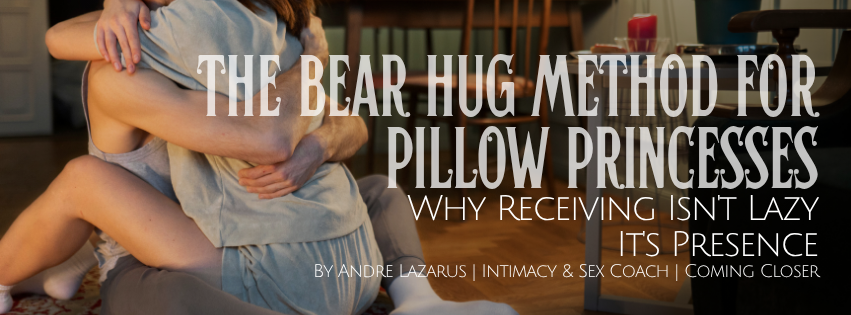
Here’s the part that actually answers the search that brought you here. The bear hug position was never choreography. There’s no sequence to learn, no rhythm to keep, no move that has to land at the right moment. It’s two bodies, standing, wrapped around each other, chests touching, breathing. That’s most of it.
Which makes it, honestly, one of the better positions for someone who doesn’t want the pressure of doing anything. You don’t have to be the one initiating a new angle every ninety seconds. You don’t have to perform enthusiasm you’re not feeling yet. You just have to be there, held, breathing, letting whatever wants to build actually build.
That’s not a lesser version of intimacy. It’s closer to the whole point. It’s the same instinct behind slow, unhurried sex: the less you’re managing, the more you can actually feel.
Receiving Is a Skill, Not a Shortcut

A lot of people assume desire is supposed to show up first, spontaneously, before anything happens, and that if it doesn’t, something is wrong with them. Sex researcher Emily Nagoski has spent years pushing back on that idea.
Her work describes what she calls responsive desire: for a meaningful share of people, wanting doesn’t arrive before pleasure. It arrives because of it. Touch and closeness happen first, and desire follows from there. Nagoski writes about this directly, and her research suggests this pattern shows up in a large share of women and a meaningful share of men too, not as a rare exception but as one of two entirely normal ways desire works.
If that’s you, being a pillow princess isn’t a shortcut around desire. It’s how your desire actually works. You may need the holding, the touch, the bear hug itself, before you feel anything close to wanting more. That’s not passivity. That’s your nervous system doing exactly what it’s supposed to do, in the order it’s supposed to do it.
This is, in a strange way, the mirror image of a pattern I write about often with the men I coach, something called spectatoring, where someone gets so caught up evaluating their own performance that they can’t feel anything at all. Different starting point, same underlying truth. Pleasure doesn’t respond well to pressure, whether that pressure sounds like “am I doing this right” or “am I doing enough.”
The Body Doesn’t Perform Well Under Judgment

There’s a physiological reason for all of this, and it’s worth understanding because it removes the last bit of guilt.
Sexual arousal depends heavily on your nervous system feeling safe enough to let go, the relaxed, rest-and-open state researchers call parasympathetic activation. Peer-reviewed research on the nervous system’s role in arousal shows just how closely that shift toward safety and relaxation is tied to how easily blood flow, sensation, and pleasure can build in the body.
Now flip that around. If some part of you is quietly monitoring whether you’re being a good enough partner, whether you owe your partner something, whether you should be doing more right now, that’s not a relaxed nervous system. That’s a nervous system on alert. And a nervous system on alert doesn’t open easily into pleasure, no matter how much you want it to.
So the guilt that sometimes gets attached to being a pillow princess doesn’t just feel bad. It can actually work against the exact thing you’re trying to feel.
How to Bring This Up With a Partner

If you’ve never said any of this out loud, here’s a place to start. You don’t need a speech. You need one honest sentence and the willingness to let the conversation feel a little awkward for thirty seconds.
Try something like: “I love being close to you, and I think I need more time being held before I feel ready to reciprocate. Can we try slowing down and starting there?”
That sentence does three things at once. It affirms the connection, so your partner doesn’t hear rejection. It names what you actually need, instead of hoping they’ll guess. And it invites them in, rather than handing them a rulebook.
If your partner asks what that looks like, the bear hug is a genuinely good answer. Suggest standing, wrapped around each other, no agenda beyond staying there for a few minutes. Let your partner know they don’t need to be doing something the whole time either. Stillness, held well, is not the absence of intimacy. Often it’s the beginning of it.
Frequently Asked Questions

Is being a pillow princess actually a bad thing?
No. It describes a preference for receiving pleasure over initiating it, not a lack of interest or effort. Most people land somewhere on a spectrum between giving and receiving, and where you land can shift with the partner, the day, and how safe you feel.
Does the bear hug position require both partners to be equally active?
Not at all. The bear hug is built around standing, holding, and breathing together, which makes it one of the more accessible positions for a partner who prefers to receive. Presence matters far more than motion.
How do I tell my partner I’d rather receive than reciprocate right away?
Lead with connection, then name the need directly. Something like “I love being close to you, I just need to be held for a bit before I feel ready to give back” gives your partner something concrete to respond to, instead of leaving them guessing.
Does preferring to receive mean I’m not attracted to my partner?
No. It usually means your desire tends to be responsive rather than spontaneous, meaning it builds after touch and closeness rather than before. That’s a documented, common pattern, not a sign of disinterest.
You’re Allowed to Be Held Without Earning It

Somewhere along the way, a lot of people learned that intimacy has to be reciprocal in real time, move for move, or it doesn’t count. It isn’t true. Some of the deepest, most regulated, most connected intimacy happens when one person simply lets themselves be held, without keeping score.
If you’ve been carrying quiet guilt about wanting to receive more than you give, that guilt was never really about you. It was about a word that got weaponized somewhere along the way. You get to take it back.
Want to explore what safe, pressure-free intimacy could look like for you? As a somatic intimacy coach, I work with individuals and couples to build connection that doesn’t depend on performance. Book a free discovery call and let’s talk about what presence, not performance, could look like in your relationship.

Andre Lazarus is a Certified Intimacy, Sex and Relationship Guide, trained Surrogate Partner, as well as Sacred Intimate with 9+ years of experience helping individuals and couples discover their intimate and erotic power. Andre specializes in erotic desire, sexless relationships, sexual trauma healing, erectile concerns, rapid ejaculation, BDSM, consensual non-monogamy, and more.
Book a discovery call and enroll into my courses to discover a deeper connection to yourself and your partner!